This was one of my favorite scarves, from a photo I took when the water lilies were blooming in the nearby lake. It was so much fun to play with Photoshop, stretching the image to fit the scarf, trying different color combinations. I never knew before what was possible. I only made one scarf like this. #americangoverness #thegirlwhotalkedtoomuch
This scarf was done from a photo of lily pads and reeds in the lake I can see from my computer as I type this. I think I like these colors better than the natural ones. Several of the lily pads had quicksilver puddles of water on their centers. I guess the alligator who lives near there was busy elsewhere; otherwise he would have lent some texture to the composition. #thegirlwhotalkedtoomuch #americangoverness
I made these scarves, and sold them at art shows. I took photos of natural subjects, manipulated their colors and shapes in PhotoShop, and then had them printed on 100% silk scarves, 18″x36″. Then we retired when art shows closed for a while during COVID. I still have some in stock, and I’m trying to figure out what to do with them. Every one is different, so they’re a bit difficult to sew into a garment. I might make them into nighties for my granddaughters, though. Here’s one:
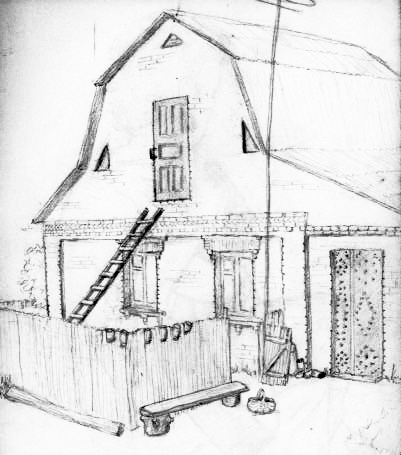
A long time ago, in 1991, I spent three weeks in Ukraine, on a trip with other Baha’is to visit the members of our Faith there. During that time, we went to a collective farm near a town called Veprik, and the Chairman of the Collective, a jolly, friendly man named Vasily, took us to his farm to begin the tour. I drew this sketch of his cozy home while we were waiting for the bus afterwards. The main door is studded with large, decorative nails. Living quarters are on the first floor, and hay storage was on the second, accessible by a ladder. the shapes on the fence are glass jars; after she washes them, his wife puts them upside-down on the fence staves to dry. Vasily made the bench from a couple of sections of a stump, with a board on top. He was very proud of the TV aerial. They were wonderful people, and I think of them often, and pray that they are all right.
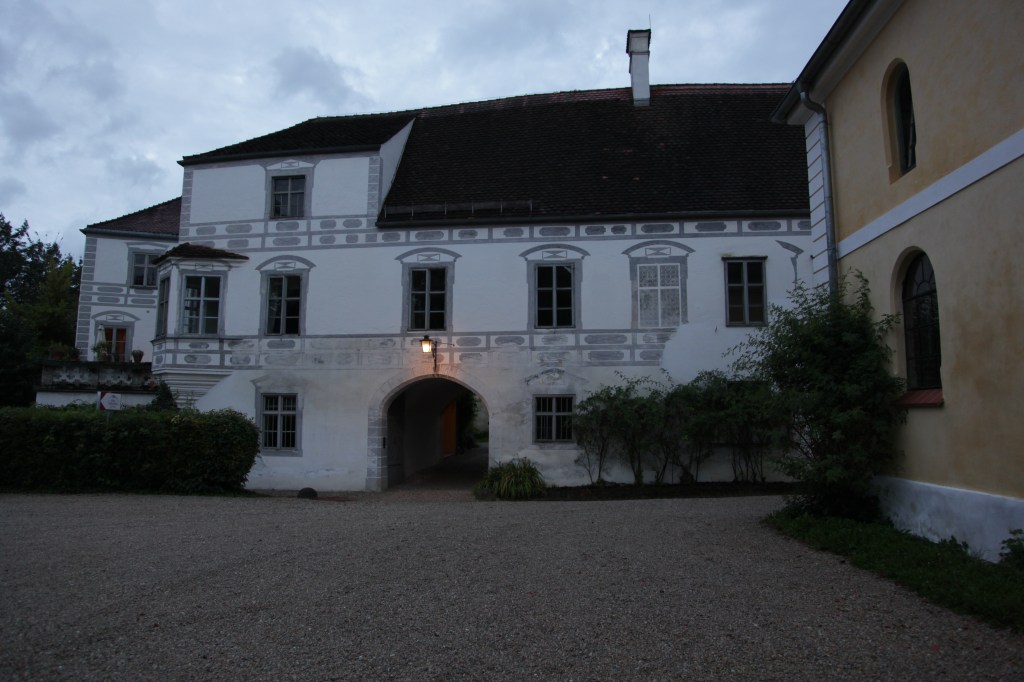
When I was a governess there, all the castle buildings were painted yellow with white trim, as seen in the building on the right (once a barn, but now a convention center). Then it was time to repaint. Since it was a historic building, dating from the 15th century, the government was involved.
During the process, they discovered that the original paint job had been white with gray accents. All the yellow paint had to be meticulously removed to expose the original surface. Government regulations require that the new paint job be the same as the original.
This photo shows the east façade of the castle, with the entry arch to the courtyard, after the yellow paint had been completely removed. I was delighted to notice the fake window that had been painted in, to preserve the continuity. Originally, it must have been done with stencils, so they’ll have to have new ones made. The downside of that paint job is that it’s more intricate and takes meticulous application, (and therefore is much more expensive) as opposed to the plain yellow. I have to confess, I did like the cheery, sunny yellow.
I’ve stayed in close touch with the Count and his family, and you may have noticed my recent blog about my decision to return two antique pieces of my folk-dancing dirndl outfit to Bavaria; a lovely silk flowered scarf, and a gold-thread headpiece shaped like a big stiff bow. They had been given to me by his grandmother, the Countess during my stay. I let Count Carl know when I sent them, and he was delighted, and said “our whole family is still involved with that dancing group.”
Just yesterday, I got an excited email from him, telling me that they’d arrived safely. He said, (in German, of course…I’m translating) “They’ve been with you since 1961, and now they come again to us. Such a wonderful idea of yours! I’ll talk with the folk-dancing group to decide who should wear them. Perhaps they could even go to our daughter Clara.”
“Yes, yes, yes! Clara must wear them….they’ll be a gift from her great-grandmother, through me, to her,” I answered. He promised to send me a photo of her wearing them with the entire folk-dancing outfit, and I’ll post it when it arrives.
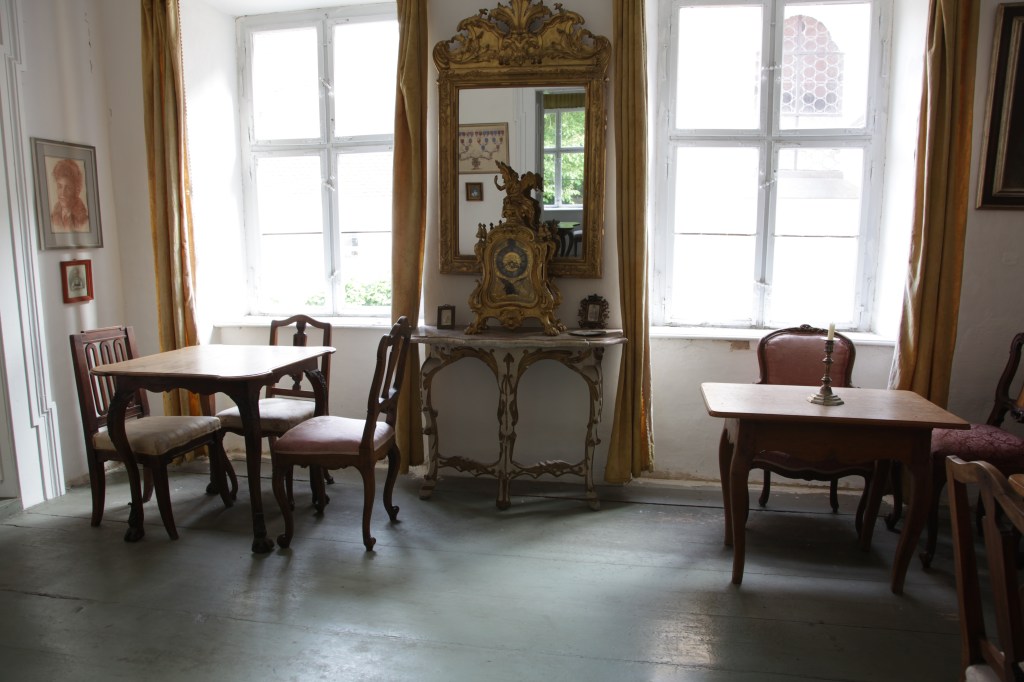
Meanwhile, here’s one of the card room in the castle. Through the window, you can see one of the arched windows of the church that’s built into one side of the courtyard.
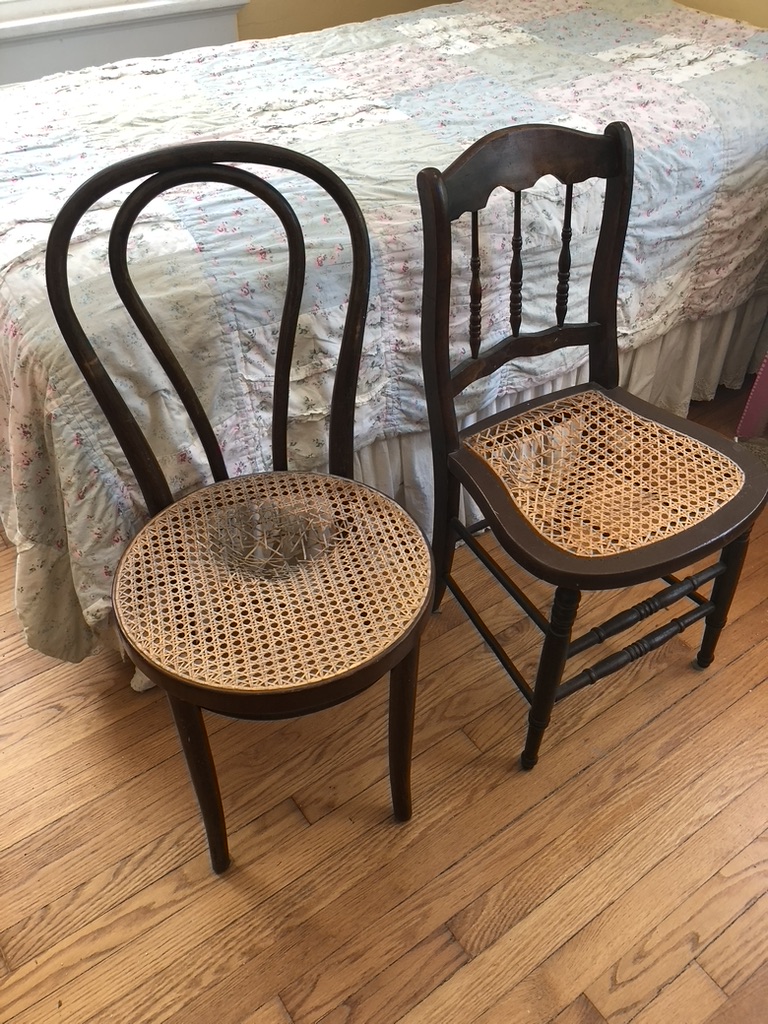
I bought these antique chairs years ago and had them re-caned, but with three growing boys in my house, they saw rougher use than they should have, and their caned bottoms have larger holes than intended. The bentwood one is probably oak, and the other is walnut, and I love them.
But I’d like to pass them on to someone else, as I try to clear unused things out of the house. I asked a couple of antique dealers, who said they didn’t buy or sell furniture any more, and that even if the caning was intact, they weren’t interested. I put an ad on Next Door, but got no responses.
I don’t want much for them. In fact, I’d probably give them away to someone who wanted them. I know that caning has become very expensive. Maybe someone who does caning would like to have them, restore them, and then sell them! Perhaps I could donate them to an institution that trains blind people to do this beautiful craft. If anyone reading this is interested in having them, contact me via email: annsargent.author@gmail.com.
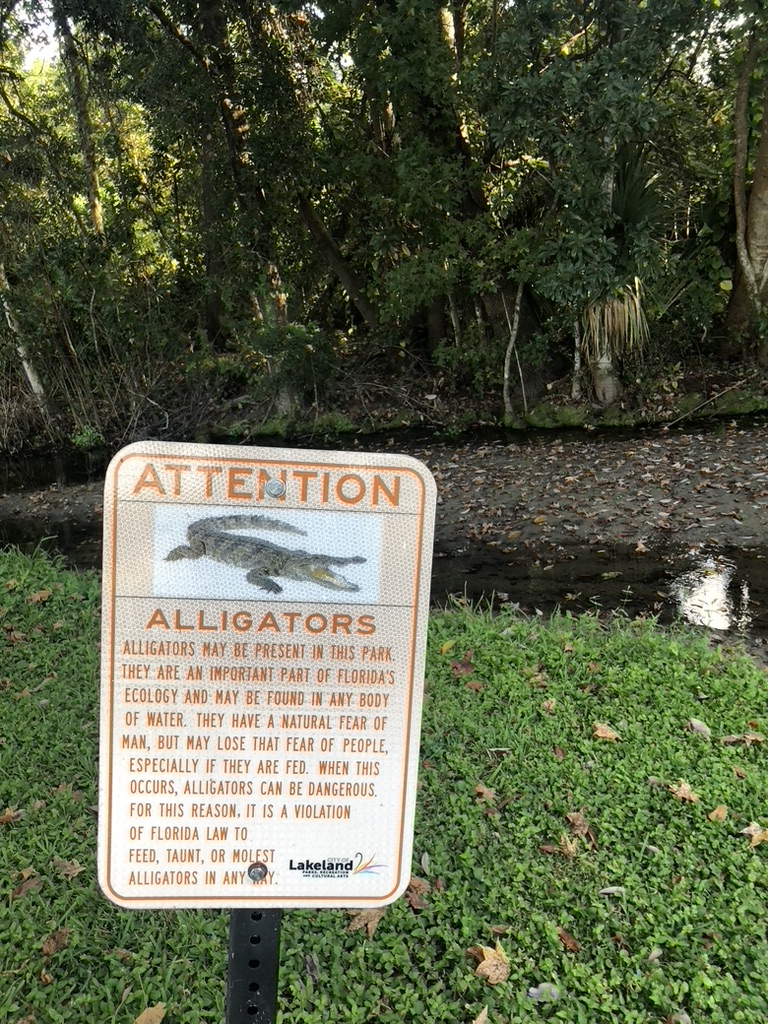
Well, I didn’t see a gator this morning, since it was barely 60 degrees, and cold-blooded reptiles move kind of slowly then. But my husband saw one earlier today, as he walked around the nearby lake. That one was lying on the surface of the water near the lily pads, soaking up the brilliant sunshine, recharging his scaly batteries.
One morning last Spring, near this sign, I heard the typical grunt that gators use to communicate with each other. Then a few weeks later, I heard a splashing, and looked over to see a very large gator thrashing his body into a spin, with something in his jaws….I think it was a duck. I’ve read that they kill prey by spinning to hold them under water. All this was going on no farther than ten feet from the walking path. And yet, I’ve never seen them up on the banks there. Which is fine with me. I hear they can run pretty fast for short distances.
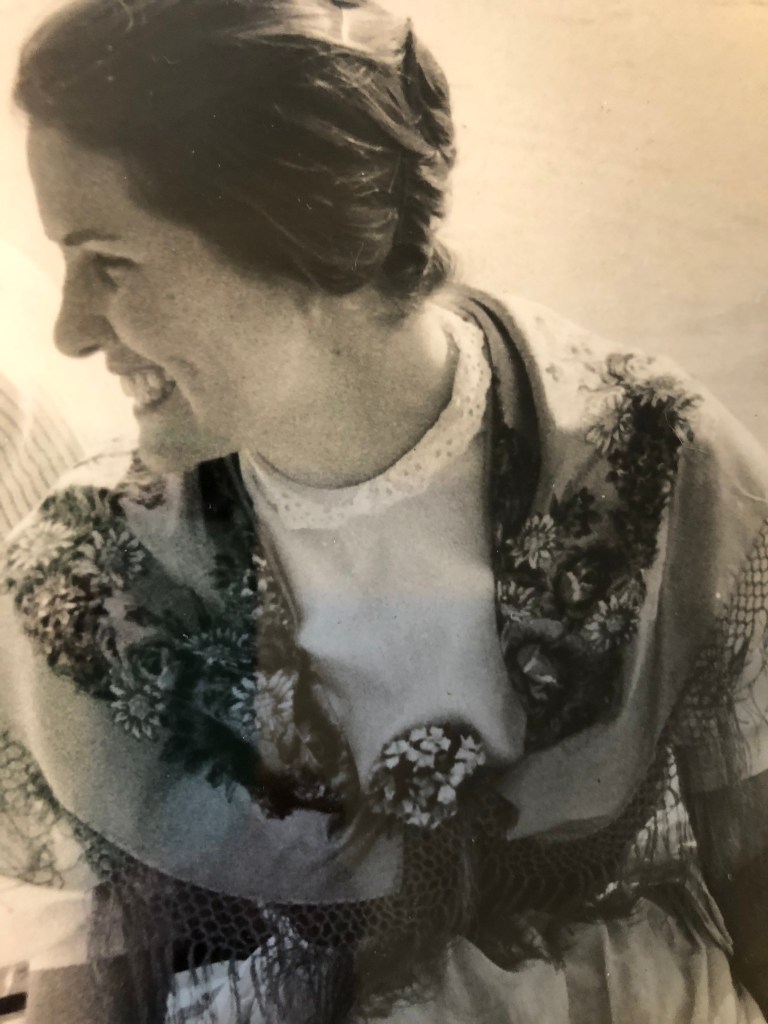
During the year I lived in the castle, I danced with a local fold-dancing group, the Hinterskirchener Trachtenverein. I’d been in a group at UF and had sewed my own dancing dirndl. It didn’t look anything local the local folk costume: mine was in the style of Upper Bavaria (the Alps) and theirs was in Lower Bavarian style (the foothills). Nobody cared; they took me in as one of their own. At Christmas, the Countess surprised me with two authentic, antique pieces of the local folk costume; a beautiful fringed, flowered scarf and a gold-thread headpiece in the form of a large stiff bow, that went over my hair in its bun.
I decided that those beautiful items need to go back to the land of their origin, and I wrote to Count Carl telling him they were coming. He wrote me back (in German, of course) telling me that they were very excited about it. The whole family is involved with the dancing group, and they’ve always supported them financially as well. When the package arrives, he’ll meet with the leaders of the group to present them. They’ll let members of their group wear them at dances, and promised to send me photos. I’m really delighted about it, and can’t wait to see them. Here’s a photo of me wearing the scarf in Bavaria.
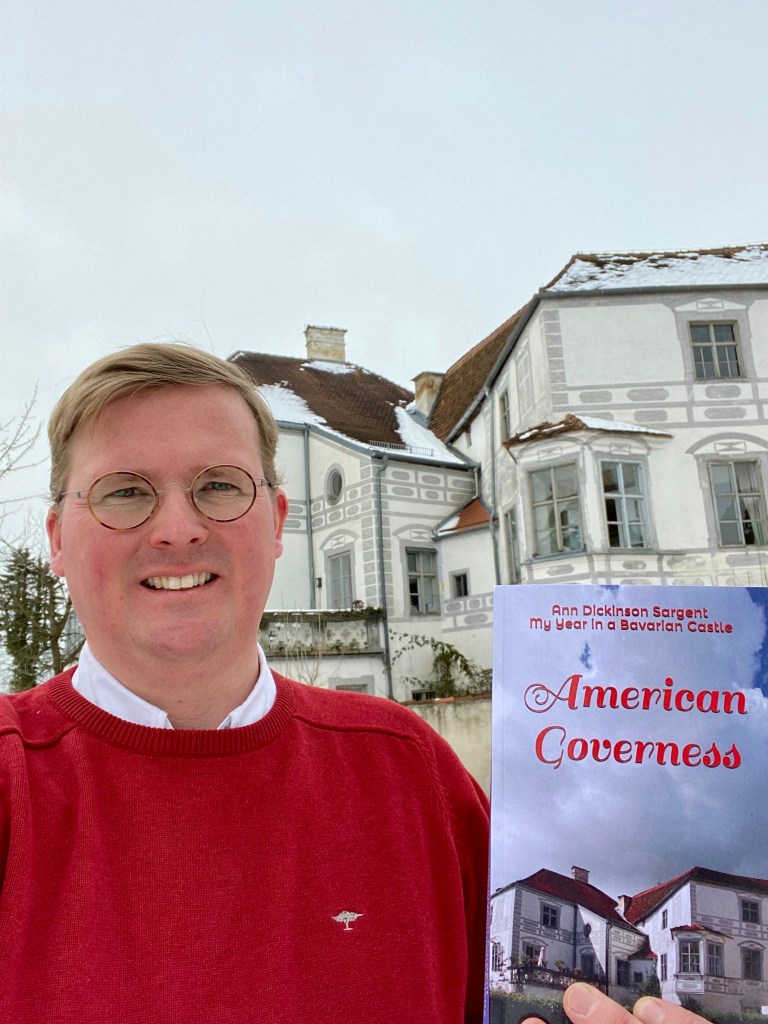
His wife, the Countess, took this photo when they received American Governess, my book about my year as a governess in their castle in 1961. Carl’s father, Christophe, was 12 years old then, the oldest of five children I helped care for and taught English to.
Before I came, the family had British governesses, but Countess Elisabet, Carl’s grandmother, wanted an American girl. She was tired of the formal reserve of British girls, and thought an American would not be so intimidated by the thought of nobility, and would be able to relax with the family. She was right. She and I felt as close as sisters by the end of the year.




 Ann Dickinson Sargent