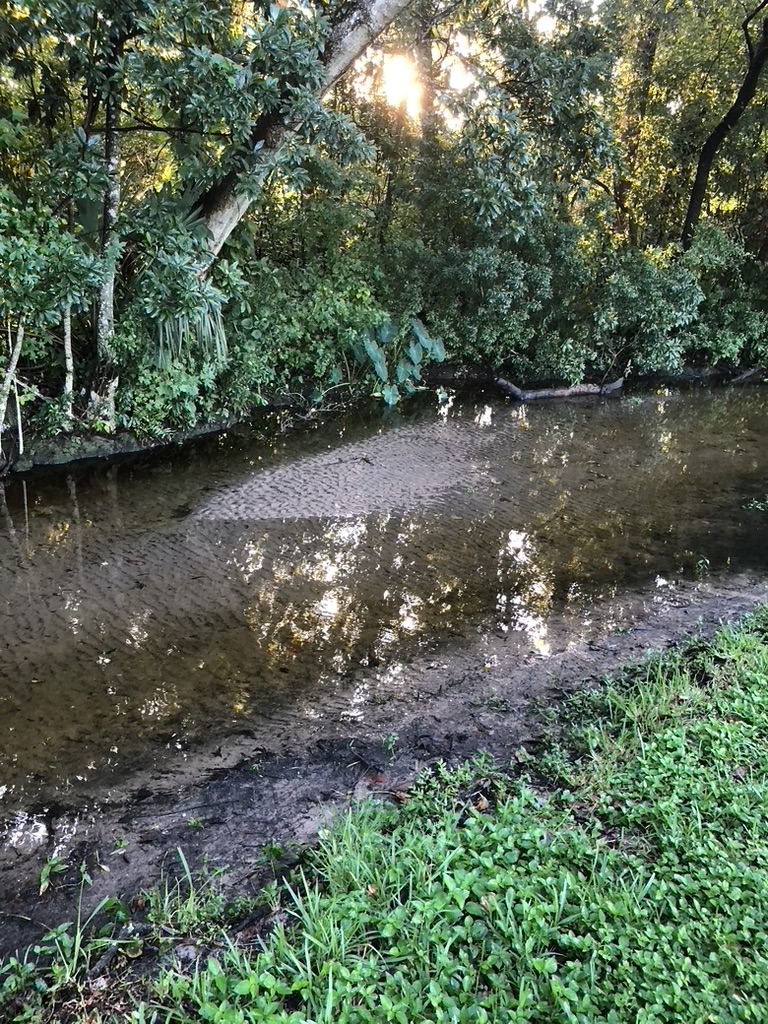
Right by my morning walking path…

Well, I didn’t see a gator this morning, since it was barely 60 degrees, and cold-blooded reptiles move kind of slowly then. But my husband saw one earlier today, as he walked around the nearby lake. That one was lying on the surface of the water near the lily pads, soaking up the brilliant sunshine, recharging his scaly batteries.

One morning last Spring, near this sign, I heard the typical grunt that gators use to communicate with each other. Then a few weeks later, I heard a splashing, and looked over to see a very large gator thrashing his body into a spin, with something in his jaws….I think it was a duck. I’ve read that they kill prey by spinning to hold them under water. All this was going on no farther than ten feet from the walking path. And yet, I’ve never seen them up on the banks there. Which is fine with me. I hear they can run pretty fast for short distances.

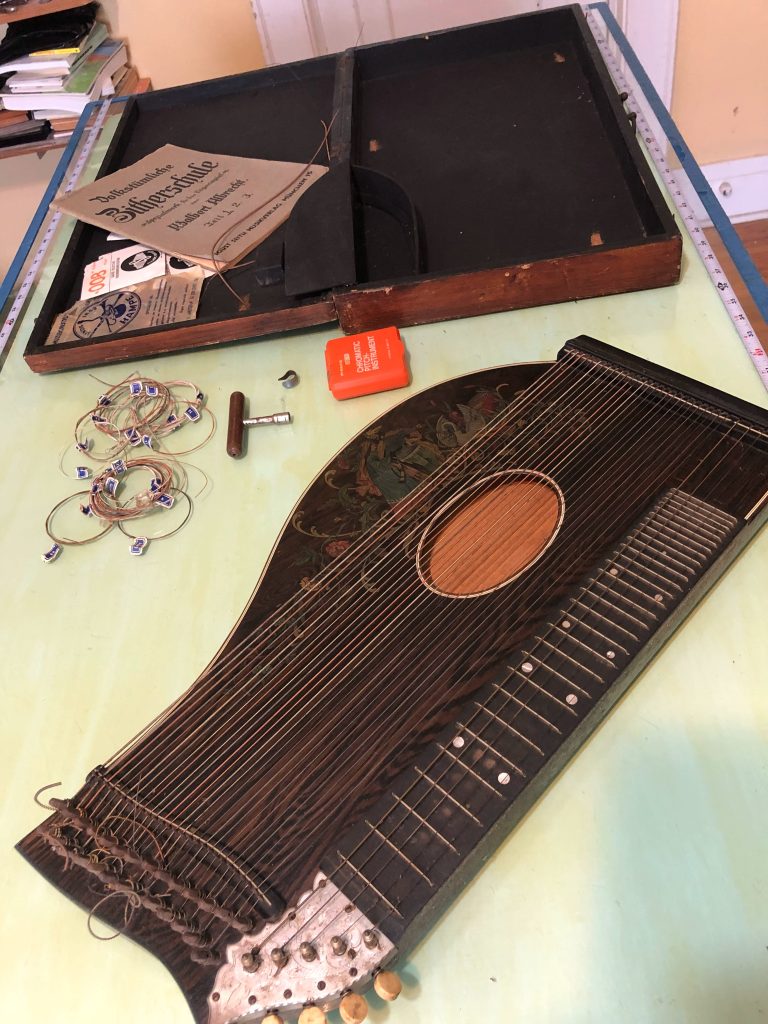
I just sent this back to Bavaria

During the year I lived in the castle, I danced with a local fold-dancing group, the Hinterskirchener Trachtenverein. I’d been in a group at UF and had sewed my own dancing dirndl. It didn’t look anything local the local folk costume: mine was in the style of Upper Bavaria (the Alps) and theirs was in Lower Bavarian style (the foothills). Nobody cared; they took me in as one of their own. At Christmas, the Countess surprised me with two authentic, antique pieces of the local folk costume; a beautiful fringed, flowered scarf and a gold-thread headpiece in the form of a large stiff bow, that went over my hair in its bun.

I decided that those beautiful items need to go back to the land of their origin, and I wrote to Count Carl telling him they were coming. He wrote me back (in German, of course) telling me that they were very excited about it. The whole family is involved with the dancing group, and they’ve always supported them financially as well. When the package arrives, he’ll meet with the leaders of the group to present them. They’ll let members of their group wear them at dances, and promised to send me photos. I’m really delighted about it, and can’t wait to see them. Here’s a photo of me wearing the scarf in Bavaria.

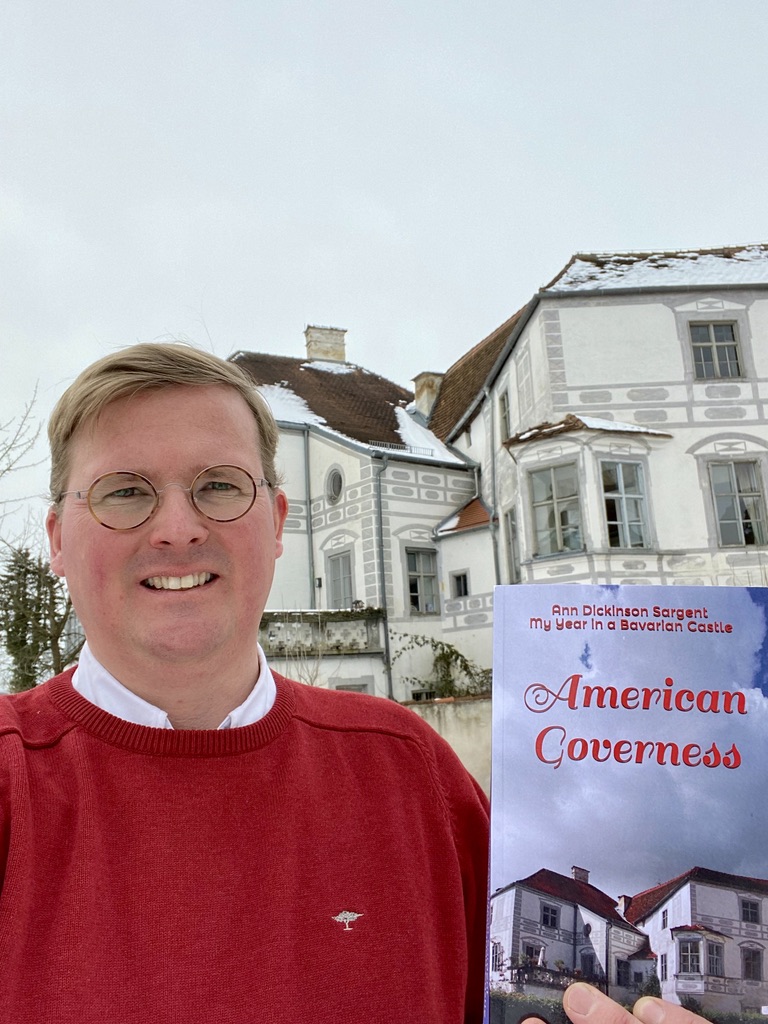
Count Carl at the castle with my book

His wife, the Countess, took this photo when they received American Governess, my book about my year as a governess in their castle in 1961. Carl’s father, Christophe, was 12 years old then, the oldest of five children I helped care for and taught English to.

Before I came, the family had British governesses, but Countess Elisabet, Carl’s grandmother, wanted an American girl. She was tired of the formal reserve of British girls, and thought an American would not be so intimidated by the thought of nobility, and would be able to relax with the family. She was right. She and I felt as close as sisters by the end of the year.

Read about all my adventures in American Governess; My Year in a Bavarian Castle!

Looking at the courtyard from the castle Ecker

The Ecker (from a word that means ‘corner’) sticks out of the side of the castle, and overlooks the entrance arch on the right, and the large house in the center. Farther to the right is the greenery of the walled castle park. It’s possible to sit here and see anyone coming to visit. In summer it’s cozy and warm from the sun. It’s on a northwest corner, so it can be cold in wintertime, particularly since these windows aren’t like others in the castle.

In the last photo of the corridor, you could see that the walls are more than a foot thick, and there are inner and outer windows, creating an insulated area. These windows are angled, and not as deep, so it wasn’t possible to double them.

In the area where the Ecker joins the inner room, there’s a heavy floor-to-ceiling lined curtain designed to be pulled in winter and to keep the drafts from coming in. Be sure to read American Governess; My Year in a Bavarian Castle, for the full story.

Take a walk in the castle….

Imagine you’re walking down one corridor of the castle where I was a governess. On the right, you can look out the windows to the far wing, and down to the central area in the hollow square of the building. If you unlatched the glass, you could lean out and look to your right to see the archway leading out of the castle. To the left you could see the Bavarian Baroque façade of the little church built into the castle itself.

Pulling back inside, you see the line of ancestor portraits hung between the windows. Immediately to your left is an area with a Persian carpet, leading to the Count’s apartments, and just beyond the wall with the tapestry you can catch a glimpse of the stair leading up to the attic.

Read this, if you can…

This is a page from one of my great-grandmother’s letters to her fiancé, my great-grandfather. It shows how difficult it was for my mother to type out a more readable version. Here’s mine:

“Meanwhile, he must keep a good heart that perhaps Henry will send him one from Porto Rico. The donnas all smoke segars there. I often laugh at them smoking the little paper segars, so if he should get one of them, perhaps she will make him smoke. I often ask myself if I shall ever sit in the corner again……and see the dear, dear girls going around the room after the rough sounds of my old fiddle. When you write me again, do not think that a foolish letter, as you call it, is not exceptable, for if I had read my Bible as much as I have read your letter, i should be a saint, almost. I now wish you a Happy New Year, and hope that before another closes, I shall have the pleasure of signing Mrs. H instead of Miss W.”

That’s only the first half, not even tackling the cross-written part. It was thin onionn-skin paper, and written crossed on the back. A few of them had a third cross-written diagonally over the others. They did this to save paper.

But by the time she was 31…..

Remember my great-grandmother, who was married at 18 in 1863? By 1876, her husband wrote to her while she was visiting New York City from Bermuda:

“I think, if you can get them to guarantee satisfaction, you had better get a new set of teeth, for your mouth does sink in so much with those old ones, and it would please me very much to see it look like it used to before you lost your teeth….”

In the 13 years of her marriage, she’d had 5 children by then (and within the next 5 years she’d have 2 more). Maybe nursing all those children took too much calcium from her system? Possibly dental care in an isolated island wasn’t good, or people took it for granted that they’d lose their teeth, but it shocks me that by 31, she’d apparently had a complete set of false teeth for some time.

They had an adequate income, and travel for dental care to New York or London aboard her husband’s ship would have cost her nothing, She had family and friends she could stay with in both places, as well as family at home who would have cared for the children during the weeks or months she’d have had to be away. But she didn’t do it.

The letters don’t mention whether or not she did as he suggested and got a new set of false teeth.

Bermudian life in 1860

It was so different in that time for those living on an island group in the middle of the Atlantic. I’ve learned from these letters that there were no schools. The islands are divided into parishes, and each tried to have some sort of teacher available. Usually young men would come out from England and start “schools” in the different areas for boys between the ages of 6 to maybe 12 or 13. They would learn their letters, and simple mathematics, and whatever else the individual young men could teach. Their salaries came from the parents paying a certain amount per student per term. Some years there was a teacher available in a particular parish, sometimes not. For further schooling, a child had to be sent to boarding school in England.

One boy mentioned in the letters, a relative, refused to go to the schoolmaster. No laws required it, and most fathers were away at sea. It was up to the mothers to enforce. No one seemed very concerned about him. He’d change his mind, or his father would make him go when he was home.

If the girls wanted to learn, there were women in the different communities who would give classes in their own homes, a few girls at a time. They also charged for teaching, much less than the boys’ official schoolmaster. One letter mentioned a woman who had to stop teaching classes because her mother couldn’t stand the children’s noise.

My great-grandfather’s first command, 1860

She was the Harvest Queen, out of Bermuda, and he was her very young Captain, only 22. He’d gone to sea since he was 14. I’m rereading some of the letters between him and his family. They date from 1839 (the last letter from his father, my great-great-grandfather, Captain of the Admiral Digby, who was lost at sea when that ship went down in a hurricane) to 1883. My Bermudian cousin, John Cox, published the compilation in 2024, after my Mother typed out the contents of the letters and donated the originals to the Bermuda Archives.

Even coming from a line of sea-captains, i used to think of their job as mainly getting the ship from one place to another, but these letters showed me it was so much more. He had to make the voyages pay. Planning a route or schedule ahead was often impossible. He took on a cargo, sailed to wherever he thought he could sell it, then bought a different cargo and found a destination to sell that. He and the ship’s owners lost money if he had to sail with ballast alone. Once in a while he sold the ship itself, if that was more profitable, and hitched a ride home with another Captain. He could never be sure how long the journeys would take because he was dependent on the wind. Other delays were caused by having to wait in port for weeks for various reasons. His sweetheart, later his wife, never knew how long it was going to be before he could get home again.

My great-grandmother in 1863

This was her engagement photo. It came to me damaged; the entire bottom part of the photo was almost black, and I managed to restore it to this point. What a beautiful woman she was, though she didn’t seem to think so. This morning I was reading a letter from her dated May 28, 1862, written to her sweetheart (whom she married the next year). She says “It really is a mystery to me that I am loved….I possess no beauty, neither am I remarkably talented as some girls are, nor do I possess any particular recommendation to attract anyone…” Maybe she was just being modest, so that he could answer about how lovely, etc, she was.

Since he, my great-grandfather, was a sea-captain in Bermuda, he was often away from home, and wrote many letters back and forth between 1857 and 1904. Cross-written on both sides of onion-skin paper, hundreds of them were all kept in a linen pillowcase, and eventually came down to my grandmother, and then to my mother, who spent years studying and typing them out. She donated the originals to the Bermuda Archives, becoming the largest collection they. had to that point. My cousin John Cox of Bermuda used them and Mother’s transliteration to publish Opened Letters, Opened Lives in 2024. I just started rereading the book, and it’s fascinating.