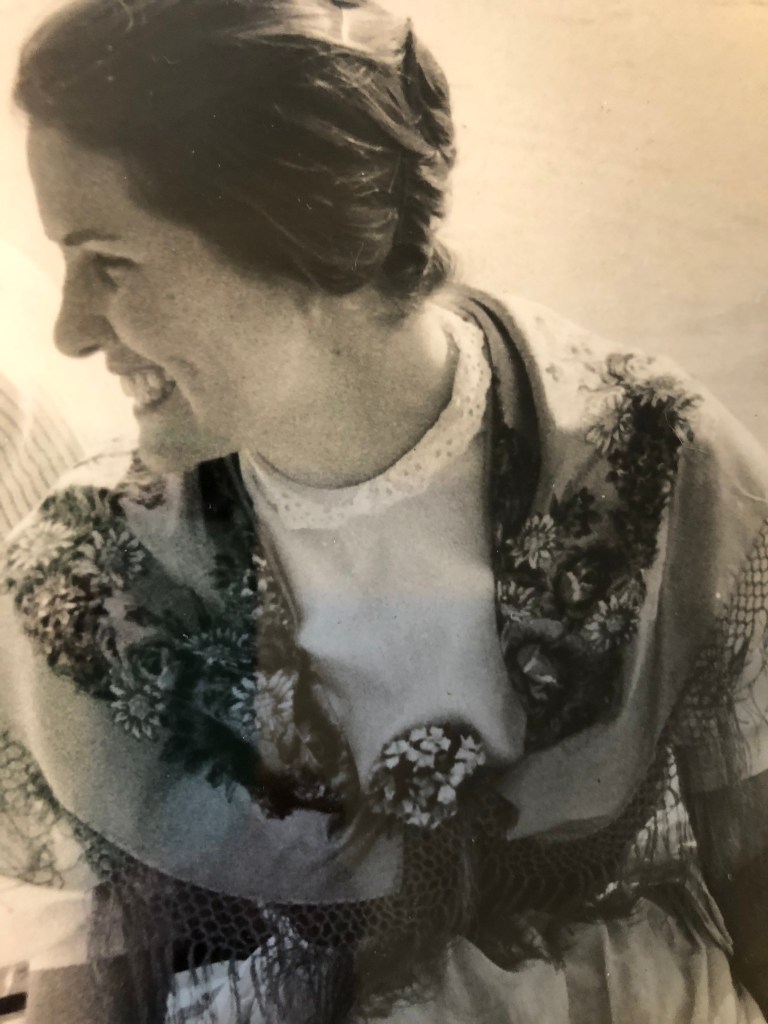
But by the time she was 31…..

Remember my great-grandmother, who was married at 18 in 1863? By 1876, her husband wrote to her while she was visiting New York City from Bermuda:

“I think, if you can get them to guarantee satisfaction, you had better get a new set of teeth, for your mouth does sink in so much with those old ones, and it would please me very much to see it look like it used to before you lost your teeth….”

In the 13 years of her marriage, she’d had 5 children by then (and within the next 5 years she’d have 2 more). Maybe nursing all those children took too much calcium from her system? Possibly dental care in an isolated island wasn’t good, or people took it for granted that they’d lose their teeth, but it shocks me that by 31, she’d apparently had a complete set of false teeth for some time.

They had an adequate income, and travel for dental care to New York or London aboard her husband’s ship would have cost her nothing, She had family and friends she could stay with in both places, as well as family at home who would have cared for the children during the weeks or months she’d have had to be away. But she didn’t do it.

The letters don’t mention whether or not she did as he suggested and got a new set of false teeth.

Bermudian life in 1860

It was so different in that time for those living on an island group in the middle of the Atlantic. I’ve learned from these letters that there were no schools. The islands are divided into parishes, and each tried to have some sort of teacher available. Usually young men would come out from England and start “schools” in the different areas for boys between the ages of 6 to maybe 12 or 13. They would learn their letters, and simple mathematics, and whatever else the individual young men could teach. Their salaries came from the parents paying a certain amount per student per term. Some years there was a teacher available in a particular parish, sometimes not. For further schooling, a child had to be sent to boarding school in England.

One boy mentioned in the letters, a relative, refused to go to the schoolmaster. No laws required it, and most fathers were away at sea. It was up to the mothers to enforce. No one seemed very concerned about him. He’d change his mind, or his father would make him go when he was home.

If the girls wanted to learn, there were women in the different communities who would give classes in their own homes, a few girls at a time. They also charged for teaching, much less than the boys’ official schoolmaster. One letter mentioned a woman who had to stop teaching classes because her mother couldn’t stand the children’s noise.

My great-grandfather’s first command, 1860

She was the Harvest Queen, out of Bermuda, and he was her very young Captain, only 22. He’d gone to sea since he was 14. I’m rereading some of the letters between him and his family. They date from 1839 (the last letter from his father, my great-great-grandfather, Captain of the Admiral Digby, who was lost at sea when that ship went down in a hurricane) to 1883. My Bermudian cousin, John Cox, published the compilation in 2024, after my Mother typed out the contents of the letters and donated the originals to the Bermuda Archives.

Even coming from a line of sea-captains, i used to think of their job as mainly getting the ship from one place to another, but these letters showed me it was so much more. He had to make the voyages pay. Planning a route or schedule ahead was often impossible. He took on a cargo, sailed to wherever he thought he could sell it, then bought a different cargo and found a destination to sell that. He and the ship’s owners lost money if he had to sail with ballast alone. Once in a while he sold the ship itself, if that was more profitable, and hitched a ride home with another Captain. He could never be sure how long the journeys would take because he was dependent on the wind. Other delays were caused by having to wait in port for weeks for various reasons. His sweetheart, later his wife, never knew how long it was going to be before he could get home again.

My great-grandmother in 1863

This was her engagement photo. It came to me damaged; the entire bottom part of the photo was almost black, and I managed to restore it to this point. What a beautiful woman she was, though she didn’t seem to think so. This morning I was reading a letter from her dated May 28, 1862, written to her sweetheart (whom she married the next year). She says “It really is a mystery to me that I am loved….I possess no beauty, neither am I remarkably talented as some girls are, nor do I possess any particular recommendation to attract anyone…” Maybe she was just being modest, so that he could answer about how lovely, etc, she was.

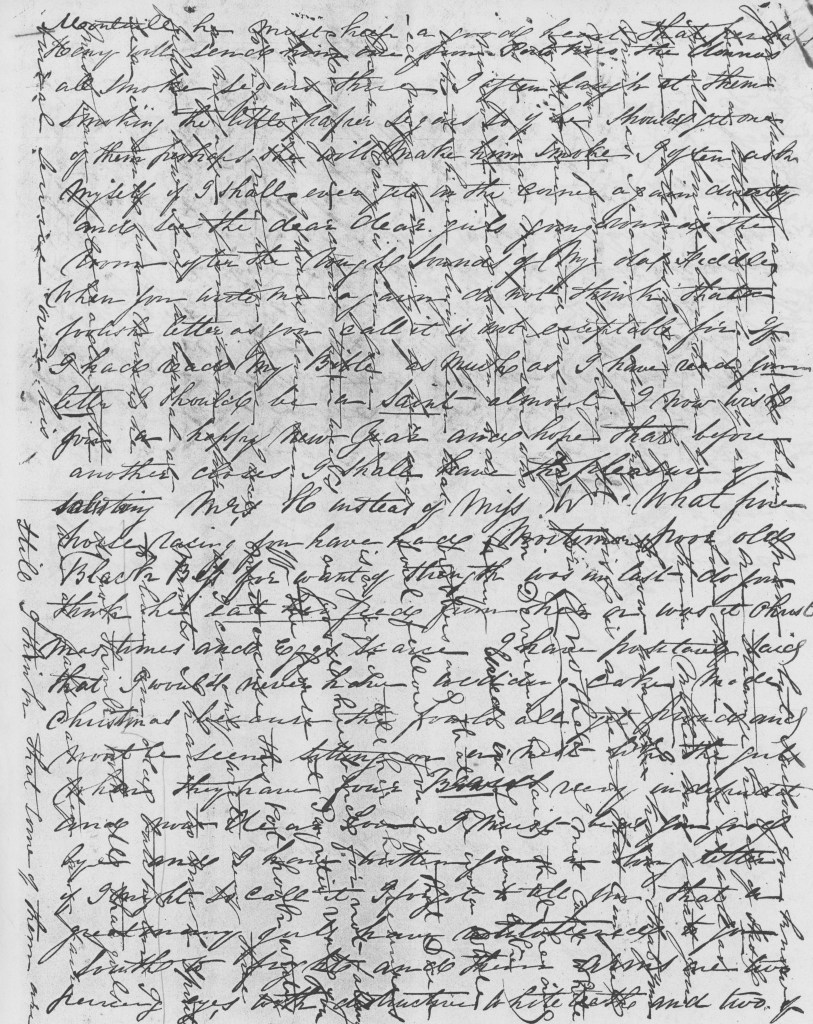
Since he, my great-grandfather, was a sea-captain in Bermuda, he was often away from home, and wrote many letters back and forth between 1857 and 1904. Cross-written on both sides of onion-skin paper, hundreds of them were all kept in a linen pillowcase, and eventually came down to my grandmother, and then to my mother, who spent years studying and typing them out. She donated the originals to the Bermuda Archives, becoming the largest collection they. had to that point. My cousin John Cox of Bermuda used them and Mother’s transliteration to publish Opened Letters, Opened Lives in 2024. I just started rereading the book, and it’s fascinating.

New Year’s Eve, 1901

In front of Brooklyn Hospital, an ambulance prepares for a trip. There’s been no snow for over a week, so they should make good time. The driver’s ready, and the doctor arrives, ready to climb aboard.

Most cities at the time had to use off-duty funeral carriages, but this hospital had its own dedicated ambulances. If the doctor sat up in front with the driver, there was even space in the enclosed back portion for a patient to recline on a padded seat. Even though there was no way to treat a patient en route, this represented the cutting edge of medical care at the turn of the 20th century.

My grandmother was Head Operating Room Nurse at BH, and my grandfather did his medical internship there. He took this picture. We donated the photos to Brooklyn Hospital Foundation. Read more about this family in The Girl Who Talked Too Much.

Christmas tree, 1915

My grandparents moved from Indiana to Auburndale, Florida, during the summer of 1915. He became one of the earliest doctors in town, if not the first. This Christmas tree was a Short-Leaf Pine, cut in the pine woods outside of town. We did the same when I was a child, I remember. What I thought absolutely delightful about this photo was that they have hung a new kind of decoration on the tree; a piece of Spanish Moss, which can be seen hanging off the right side of the tree..

This moss only grows south of a certain area (roughly equivalent to the Mason-Dixon Line that separated the US Northern states from the Confederacy in the Civil War)….they would never have seen it before, and must have admired its delicate structure.

We’re so used to it these days that we’d never think of using it that way. Though not a parasite, it can break branches of smaller trees like Crape Myrtle, if it gets too dense and then gets weighed down by rain. Tree companies are often hired to remove Spanish Moss from oaks when they prune the branches. I like being able to look at it a different way!

Follow much of their story in The Girl Who Talked Too Much!

Christmas dinner, 1906

My mother is the baby who sleeps soundly in her father’s arms, as her mother and other relatives look on fondly. The candelabra (minus the little shades) is now in my son’s house. I’ve tried to figure out the foods on the table, besides the centerpiece of apples, and I think that’s a glazed ham on the right, a mound of mashed potatoes in the farthest bowl, and maybe slices of toast in the left foreground. Napkins are still lying on plates, so they hadn’t begun to enjoy the dinner at this point. Read their story in The Girl Who Talked Too Much.

Brooklyn Hospital children’s ward, 1902

My grandfather is the doctor in this photo. I’m guessing he’s palpating the glands of the baby the nurse is holding. Notice the child on the left in the foreground (a girl, I think, since she’s wearing a nightgown). She’s sitting in a wicker wheelchair, and she and the little boy are reading a large book or maybe looking at a photo album. The child in the background looks bald, and closely shaved haircuts for boys weren’t common till crew cuts became popular.

Ma Google tells me that chemotherapy and radiation were used experimentally for cancer treatment in 1900, so there is a possibility he was being treated for that. I think it’s more likely that his head was shaved to stitch a laceration, and because it would be much easier to keep the skin clean afterwards. But that’s only a guess.

This was part of the collection of his photos that we donated to the Brooklyn Hospital Foundation. They were very pleased, and said that earlier they’d only had blueprints of the hospital’s layout, but no interior views. Also, many of the staff were identified in the albums. Earlier, they had lists of doctors and nurses, with dates and professional responsibilities, but no photos of them, and were frustrated when descendants would write in and ask for information concerning forebears who worked there. With this collection, they could match names with faces. For example, the nurse on the left is identified as Miss Waddell, although the other two were not named.

The story of my grandparents’ courtship can be found in The Girl Who Talked Too Much, recently published on Amazon.